
Air pollution
How does air pollution damage both human health and the natural environment?
Long-term exposure to air pollution increases the risk of heart disease, stroke, lung diseases and lung cancer. Emissions of nitrogen oxides (NOx), from aeroplanes but also from road traffic around airports, can also negatively impact plant diversity, while friction from tyres on the road releases particles representing 5 -10% of microplastics deposited in the oceans.
While air pollution levels have generally fallen in the UK, transport remains a problem and measurements of roadside NO2 levels regularly breached legal limits during the 2010s.
Friction from tyres releases particles representing 5-10% of microplastics deposited in the oceans.
How much air pollution comes from aeroplanes and airports?
Airports generate air pollution from a number of sources, including the aircraft themselves, on-site power and heating, equipment to service aircraft, on-site vehicles and airport-related traffic on surrounding roads (staff, passengers and freight).
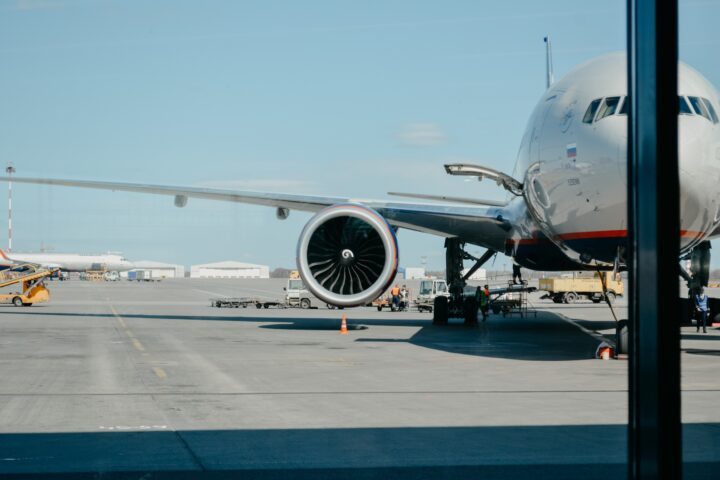
Vehicles travelling to and from airports are often the biggest contributor to local concentrations of pollutants, especially where airports are located in or near major urban centres or transport networks where they exacerbate existing air quality problems.
Studies have identified airport-related emissions 20 miles from the runway.
Aircraft and airport operations produce gaseous pollutants including the following:
- Nitrogen oxides (NOx): The majority of NOx emitted from combustion is in the form of nitrogen oxide (NO), but this oxidises rapidly to form nitrogen dioxide (NO2) which is well documented to be harmful to health. NOx gases react with particles in the air to form particulate matter (PM) and ozone (O3) which also impact upon health (see below).
- Sulphur dioxide (SO₂): is a corrosive, acidic gas formed from the combustion of fuels that contain sulphur—jet fuel has a significantly higher sulphur content than road fuels. Once emitted, SO₂ can also interact with other particles in forming PM.
- Volatile organic compounds (VOCs): are a large group of organic compounds which react with other air pollutants (e.g. NOx) to produce ozone. VOCs can be carcinogenic, cause respiratory problems and contribute to the formation of PM. Key VOCs produced by aircraft include benzene, propane and formaldehyde.
- Ozone (O3): is a pollutant that is not directly emitted by primary sources, instead being formed when other gases (most frequently NOx and VOCs) react with sunlight. In the stratosphere, ozone reduces the amount of harmful UV radiation that reaches the Earth. In the troposphere (ground level up to ~10km), it is a powerful greenhouse gas and air pollutant that causes smog harms human health (causing ~1 million premature deaths per year) and ecosystems (e.g. reduced crop productivity).
- Carbon monoxide (CO): is a toxic gas that is a product of incomplete combustion. Emissions of CO are relatively higher during taxi and descent as incomplete combustion is more common at reduced power.
Solid and liquid particles emitted into the air are called particulate matter (PM) and are typically classified by size.
- PM10 – particulate matter with a diameter of 10 micrometres or less
- PM2.5 – 2.5 micrometres or less
- Ultrafine particles (UFPs) – 0.1 micrometres or less (100 nanometres)
Most particles are small, below 0.1 micrometres, but most of the mass of PM is made up of larger particles. PM is classed as volatile (vPM) or non-volatile (NvPM). NvPM refers to products resulting from incomplete combustion, primarily soot. vPM describes liquid droplets from condensed combustion exhaust gases that start small and grow in size quickly, sometimes by coating non-volatile soot particles.
The health impacts of the pollutants emitted by aircraft are largely well understood, although the body of academic literature on ultrafine particles (UFPs) is smaller because they are very difficult to study. There are added complications with emissions from aircraft as their distribution is affected by the altitude of the plane and wind direction. Official guidance suggests that emissions should be assessed only up to a height of 1,000m (the landing and take-off cycle) as, above that altitude, emissions are thought to disperse over a wide area. This disregards emissions of small particles at higher altitudes, yet studies have identified airport-related emissions tens of kilometers away from airports.
Are the Government and regulators doing enough?
Action from regulators and the industry currently falls short. Day-to-day responsibility for tackling air pollution rests with local authorities, though they are limited in terms of both powers and resources. For example, the local authorities adjacent to Heathrow Airport and charged with maintaining air quality levels below legal limits have no powers to stop or reduce the airport’s operations if limits are not being met. When it comes to planning decisions, local authorities’ concerns over air quality impacts can be over-ridden by the Secretary of State.

The Government is ultimately responsible for ensuring that the UK complies with air quality regulations, but the UK’s legal limits are lagging behind international counterparts and are not sufficient to protect human health. The current legal NOx limit that is twice as high as permitted in the European Union, and four times as high as the World Health Organisation recommendation.
The draft Heathrow Expansion National Policy Statement (HENPS) published by the Department for Transport in 2026 and sets out the policy framework for the construction of a third runway at Heathrow, does not include any enforcement mechanisms for ensuring that expansion does not proceed if it would either cause or worsen a breach of air quality limits. It also permits a huge increase of around 60,000 vehicles a day travelling to the airport.
Many airports have their own policies in place to try to minimise the air pollution impact of their operations, but these are often limited in scope, e.g. increasing the use of electric vehicles on-site. While airports may set targets to increase the percentage of passengers travelling to and from the airport using public transport, they are often reluctant to go too far in discouraging drivers given the amount of money generated through car parking charges. In terms of aircraft manufacture, the UN aviation body ICAO regulates NOx emissions from aircraft engines and agreed a new standard in 2019 for particulate matter, although standards have historically tended to reflect currently available technology rather than referencing health-based goals. Recent figures from DEFRA showed that NOx emissions from aircraft increased 10% from 2023 to 2024, while emissions from all other transport sources of NOx are falling.
