
Briefing: Ultrafine particles from aviation
15th April, 2026
What are ultrafine particles and what do they have to do with aviation?
Airports emit forms of air pollution, coming from aircraft engines, ground support equipment, and associated road traffic. The types of gases and particulate matter includes: nitrogen oxides (NOx), sulphur dioxide (SO₂), volatile organic compounds (VOCs), Ozone (O3), carbon monoxide (CO) and particulate matter (PM). Ultrafine particles, also known as UFPs, come under the category of particulate matter, and are classified by their size.
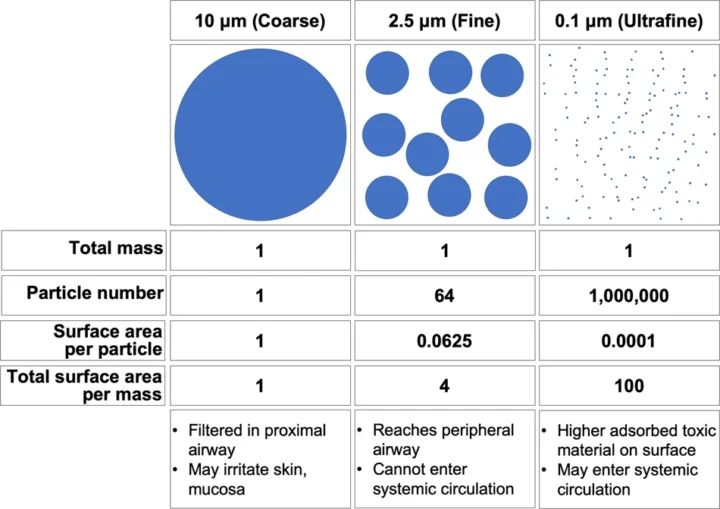
Ultrafine particles (UFPs) are the smallest category of PM, having a diameter less than 0.1 micrometers. Ultrafine particles are one type of air pollution emitted that has been under increasing scrutiny, with several negative health impacts being linked to UFP exposure. Part of the concern is to do with UFPs size, with some evidence that indicates that the relatively small size of UFPs results in a deeper penetration into the body and the ability to carry relatively more toxicants due to surface-area to mass ratio.
Comparison of the surface area of particles with different diameters:
What should be done to combat UFPs from aviation?
AEF has put together a full briefing detailing the current policies and policy blockers for UFP regulation and recommendations for future policies to combat this air pollution.
Photo credit: Amir Mortezaie, UnSplash