
Giving wings to contrail mitigation: a template for international cooperation
29th October, 2025
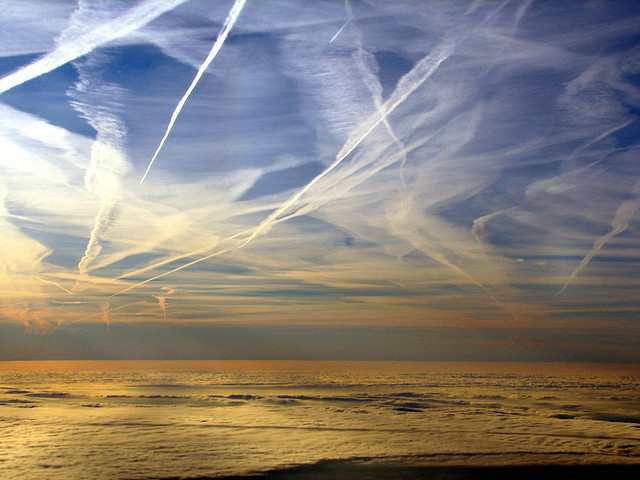
Contrails, or to give them their full title, condensation trails, are a regular sight in the skies over the UK, criss-crossing each other in the wake of aircraft flying at altitude.
But while a contrail lit up by the setting sun may catch your eye, these contrail clouds, formed when aircraft pass through cool and saturated air, make a significant contribution to climate change. In fact, the science tells us that aviation’s non-CO2 climate impacts – and contrails are responsible for the majority of these impacts – represent two thirds of aviation’s climate warming impact to date. And yet they don’t feature in any climate goals or targets for the sector, although the European Union recently introduced a requirement for flights within the EEA region to start monitoring and reporting.
The lack of action to date has, in part, been down to scientific uncertainties, but there is sufficient understanding to conclude that reducing or eliminating contrails could provide climate benefits. Improved prediction of the meteorological conditions that give rise to contrails creates an opportunity for air traffic controllers to reroute aircraft into regions where they are less likely to form, either by changing flight altitude or taking a different route (recognising the need to minimise any additional fuel burn). Unlike carbon dioxide emissions that remain in the atmosphere for centuries, the impact of contrails can be measured in minutes, hours, weeks and months. With warnings that the Paris Agreement’s aim to limit temperature rises to 1.5oC may already be out of reach, tackling contrails could buy us valuable time.
Despite the lack of policy signals, contrail mitigation has been gaining interest and several airlines have been participating in trials to help with measurement, prediction and observation. In the UK, the Jet Zero Taskforce currently has a task and finish group looking at the potential for contrail mitigation. As most contrails are observed over Europe, North America and the North Atlantic, the UK is well placed to take an international lead. But to be effective, international collaboration will be key, especially with the four other countries that provide air navigation services for the north Atlantic region, namely Portugal, Canada, the United States and Iceland.
International cooperation will be key
We asked the legal experts at Opportunity Green to explore the mechanisms that could form the basis of an international agreement on contrail mitigation in the future. Opportunity Green reference existing international treaties, that address matters of atmospheric pollution, to highlight how effective they are, and to inform an assessment of any associated risks. Their briefing highlights that the most effective international treaties share common themes including the utilisation of ‘executive committees’ or ‘working groups’, and procedures to promote compliance. Another key to success is having a narrow subject matter and the inclusion of an accountability mechanism.
The research also identified that while a new treaty between a willing coalition of states may be most appropriate mechanism to support contrail mitigation in the longer-term, a non-legally binding form of cooperation at the outset is likely to provide a more flexible framework that could be quicker to negotiate and put in place.
Read or download the report below: