
Aviation and Environment News – April 2026
9th April, 2026
In this edition of AEF’s news update we will take you through the reporting trends that have been developing in the last few months, including a back and forth over the state of the aviation industry’s environmental commitments.
Plain Sailing?
‘This is real progress, not a future promise’
The aviation industry has generally been confident about meeting sustainability targets through the backing of a whole host of tech and efficiency measures. The above quote from Matt Gorman (director of carbon strategy at Heathrow), about ‘Sustainable Aviation Fuel’ or SAF sits firmly within this optimistic outlook alongside these other pieces:
- Revealed: how aviation emissions could be halved without cutting journeys
- The man on a mission to fuel flights with food waste – ‘“I would like flying to be universal”
- Air travel demand will more than double by 2050
These have been matched by a string of positively reported developments relating to fuels, including new plans for a £600 million SAF plant in Humberside. See also:
- Singapore sets first ever sustainable aviation fuel levy, as Southeast Asia’s fuel industry grows
- A push to boost sustainable aviation fuel incentives gets bipartisan support
- Clean fuel producers reject airline concerns over SAF mandates
- Europe’s first electric flight to take off from Glasgow
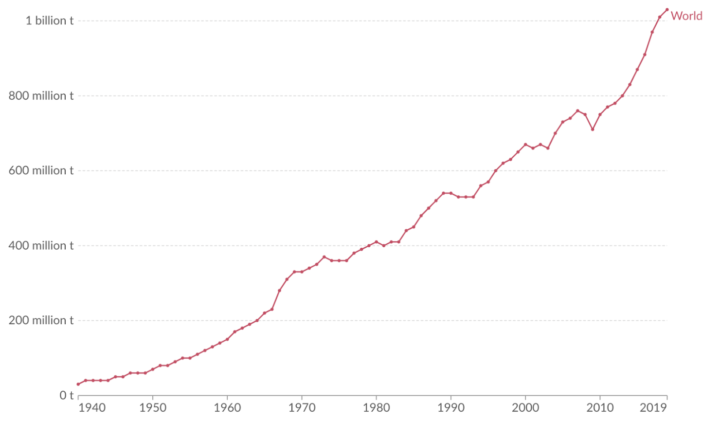
This consistent hopeful framing alongside a habit of highlighting progress at any opportunity has perhaps been designed to make it look like cleaning up aviation is almost inevitable, with an air of confidence in the delivery of cuts to emissions, noise and air pollution. This is despite overwhelming evidence that environmental problems are deepening, with growth of the industry showing no sign of slowing down.
Global CO2 emissions from aviation, 1940 to 2019
CC BY 4.0: OurWorldInData.org/global-aviation-emissions
Is the industry front starting to crack?
‘How politicians and passengers gave up on green air travel’
The unity of the sector across their environmental claims has worked to great effect in the past (e.g. see: Are technology myths stalling aviation climate policy?). However, as pressure to act grows, an increasingly divided approach has appeared in the media over the last few months, with ‘solutions’ being painted as too difficult and expensive to implement. Even SAF, despite being the least disruptive technology to the status quo, has begun to generate conflict both within the industry and between the sector and legislators. Several articles have been published questioning SAF supply, rules and sustainability claims:
- Airlines warn green fuel goals at risk as supply falls short
- European airlines plan challenge to EU synthetic jet fuel rules
- Jet-Fuel merger could hinder China’s effort to decarbonize its skies, insiders warn
- How a Texas refinery turns Amazon-destroying cattle into ‘green’ jet fuel
- Airlines are pushing for plant-based fuel – but it could make your weekly shop dearer
Other pieces have covered issues with zero emission aircraft development, the challenges of contrail avoidance and called into question the ongoing push for airport expansion:
- ZeroAvia rejigs certification plan after funding constraints force sweeping layoffs
- Labour donor Dale Vince pulls plug on net zero airline
- Technology can cut plane contrails by two-thirds. Getting airlines to use it isn’t so easy
- Heathrow’s £49bn third runway ‘a vanity project’, experts warn
- UK must speed up net-zero aviation, says Tony Blair
- Airport expansion will put UK’s net zero goal in ‘serious jeopardy’, MPs warn
The last of these articles delves into the recommendations of the cross-party environmental audit committee (EAC) inquiry into airport expansion in the UK. The inquiry deemed current policies insufficient to deliver a reduction in carbon emissions from the aviation sector in line with carbon budgets. AEF provided written and oral evidence during the inquiry last year.
What about the UK Government?
Industry optimism has been matched by an apparently steadfast belief in the UK Government that a sector recognised as ‘hard to abate’ can keep growing whilst cutting carbon emissions. Before Christmas, the transport secretary, Heidi Alexander, announced the launch of the review of the Airport National Policy Statement, which provides a framework for expansion at Heathrow. The Government also indicated their support for Heathrow Airport’s proposal for a third runway (over a rival bid from Arora Group).
More recent news from the Government:
- The Government published their official response to the EAC report in December, reiterating support for growth and expansion whilst offering little (if any) new commitments to address the committee’s concerns.
- The decision to approve the use of a new runway at Gatwick Airport was under judicial review in the High Court in January, with a decision expected soon
- The long-awaited CBGDP that outlines policies to reduce emissions up until 2037 was published in October—AEF’s interpretation of what the plan means for aviation is available here. The plan continues to leave aviation reliant on SAF, removals and offsets and a lack of new published modelling makes it difficult to fully interpret the figures. This issue came to light in the Gatwick inquiry, with Heidi Alexander disclosing that her department had made a forecasting mistake in the CBGDP aviation efficiency figures of 4.1Mt CO2.
In other news..
While cracks in the aviation industry’s united front already seemed to be appearing, the current geopolitical context may bring these divisions to the surface even faster. There has been some suggestion that airlines will use this moment to push for rollbacks of environmental commitments and legislation as jet fuel prices rise. The SAF levy in Singapore has already been deferred for nine months in response to the disruption. Several outlets have begun speculating on what the ongoing crisis in the Middle East might mean for the sector and passengers in the longer term:
- Prepare for turbulence – how a prolonged Middle East conflict could reshape how we fly
- Jet fuel price shocks prove aviation must pay its way
- What Soaring Fuel Costs Mean for Your Air Travel
- Despite soaring jet fuel prices, air fares aren’t up that much. But they will be
- SAF prices rise as jet fuel markets tighten amid Middle East war
- Oil prices highlight need to develop electric aircraft – Loganair boss
- Thousands of flights cancelled as jet fuel costs soar
- Jet fuel rationing introduced at four airports in Italy
- UK is Europe’s ‘most vulnerable’ market to jet fuel disruption, says Ryanair chief
Other headlines have continued to cover developments at Heathrow alongside other policy updates in the UK and across Europe:
- Revealed: US bid to cap soaring cost of Heathrow’s third runway
- MPs want overhaul of Heathrow regulation before third runway
- Airlines and Heathrow split over third runway
- Revealed: The worst London postcodes for airplane ‘flight blight’
- UK aviation reforms could sideline public input over flight paths, campaigners warn
- Airlines should tell UK customers the carbon impact of flights, watchdog says
- Reform UK vows to scrap tax for short-haul family flights
- Why the climate crisis is especially bad news for frightened flyers
- Flight limit at one of Europe’s busiest airports scrapped
- Netherlands to increase tax on private jets
Further reading and new reports
CAA – New CAA data suggests 2026 will be another year of growth for the aviation sector
DfT – Exploring the effect of carbon labels on consumer flight choices
Dr Alan Whitehead – Independent Review of Greenhouse Gas Removals
InfluenceMap – Corporate Capture and the UN International Civil Aviation Organization
InfluenceMap – The Aviation Industry’s Playbook to Stall the EU ETS by Leveraging CORSIA
Safe Landing – ‘Creating the future of aviation’ Visioning Assembly
Sasha Coalition – Leading the race to zero carbon emission flight
Sasha Coalition – How is CORSIA delaying aviation decarbonisation?
Transport & Environment – CrOP30: Why burning food for land-hungry biofuels is fuelling the climate crisis
Transport & Environment – Here’s what Europeans from 7 countries think of rail booking processes
Transport & Environment – Aviation taxes, charges and fees have limited impact on passenger numbers
UKELA – International Legal Order: Help or Hindrance in Decarbonising Aviation?
And some quotes from academic papers:
‘70% of complaints fall outside the noise contours established by the airport’s Specific Noise Zoning Plan, highlighting significant regulatory limitations’
‘A decades-long trend of falling airfares is expected to reverse’
‘What, if anything, might make leisure-flying irreplaceably or uniquely valuable for would-be-travelers’
‘The findings reveal a novel theoretical mechanism, “future soothing”: projecting technological salvation into a perpetually deferred future to ease public concern and postpone regulation’‘
A majority of the global population prioritizes environmental protection over economic growth’