Alternative Aviation Fuels (SAFs)
Aircraft currently use fossil-based kerosene as fuel.
One solution to aviation’s decarbonisation problem is the development of alternative fuels, which are based on non-fossil based feedstocks. Some examples include using used cooking oil, black bin bag waste, ethanol or waste forestry or crop residues. Some countries permit the use of biofuels (based on feedstocks such as palm oil), but these are not permitted in the UK due to the real concerns about deforestation and competition for scarce farmland for growing fuels, not food crops.
These fuels have been dubbed “sustainable” because in theory they represent a closed loop of carbon dioxide emissions – it’s assumed that methane and CO2 which would be released from rotting waste is not emitted if the waste is used as a feedstock. Alternative fuels emit the same amount of CO₂ when they are combusted, but they should displace the use of fossil CO2 which adds to the total in the atmosphere. Government estimates suggest that SAFs can reduce emissions on a lifecycle basis of up to 70%.
SAFs still emit the same amount of CO₂ when they are burned as traditional jet fuel
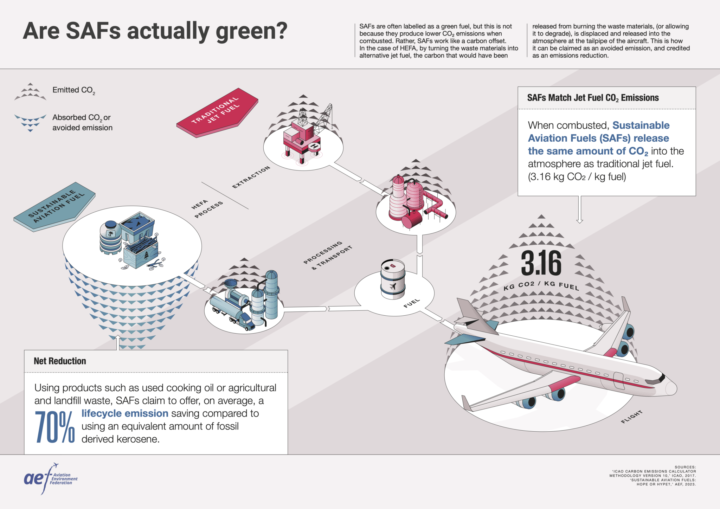
AEF is clear that these emissions savings must be constantly assessed and monitored, and not merely assumed based on underlying methodologies.
The UK SAF mandate
In 2025, the UK government introduced a SAF mandate which is an obligation on fuel suppliers to supply a minimum of 2% SAF alongside traditional kerosene – this proportion increases to 10% by 2030 and 22% by 2040. The SAF mandate also includes a small percentage of e-fuels, or synthetic fuels, which should be developed by 2030. E-fuels use extracted CO₂ as a feedstock, which means they are capable of actually reducing emissions from the atmosphere if production emissions are sequestered, however they are very energy intensive and expensive to produce.
Alongside the SAF mandate, the UK government is also introducing a Revenue Certainty Mechanism (RCM), which is a guarantee to producers that they will receive a strike price for fuel they produce – this is to be funded through a levy on the fuel supply industry and not taxpayer’s money. There is also a mandate in the EU known as Refuel EU, and in the US there are subsidies for SAF producers. However, as things stand, the global supply of SAF is still very slow, it is expensive, and there is not sufficient waste feedstock to meet multiple global mandates.