
Non-CO₂ effects of aviation (including contrails)
Aviation causes additional emissions and warming beyond the impact of CO₂ alone – known as non-CO₂.
These emissions include sulphur, nitrogen oxides, particles including black carbon (soot) and water vapour (which in turn can form contrails). Some of these emissions cause extra climate warming high up in the troposphere, and some cause cooling. The precise balance of the overall ‘radiative forcing’ of these interactions is generally agreed to be about 2-4 times the size of the warming impact of the CO₂ emissions alone, although there remains a level of scientific debate. AEF believes this is not sufficient to prevent action on non-CO₂ emissions, especially as nitrogen oxides and black carbon also contribute to harmful air pollution at ground level.
The precise balance of the overall radiative forcing of these interactions is generally agreed to be between 2 and 4 times the size of the warming of the CO₂ emissions alone
The outsize impact of contrails
In recent years, scientific understanding of the enormous impact of contrails on global warming has developed significantly. Contrails are the white lines often seen behind planes flying over-head. They are formed when water vapour condenses and freezes over soot particles emitted high in the atmosphere in ice super-saturated regions (cold air). In certain conditions, the contrails can develop into persistent cirrus clouds, which have the effect of trapping heat on the earth’s surface at night (however their effect during the day is to prevent extra radiation from the sun reaching earth).
The latest science estimates that the extra warming caused every year by the formation of contrails is about the same as the warming impact of ALL the CO₂ emitted from aviation since 1945 – contributing to roughly 0.1C of the warming impact we will expect to see by 2050.
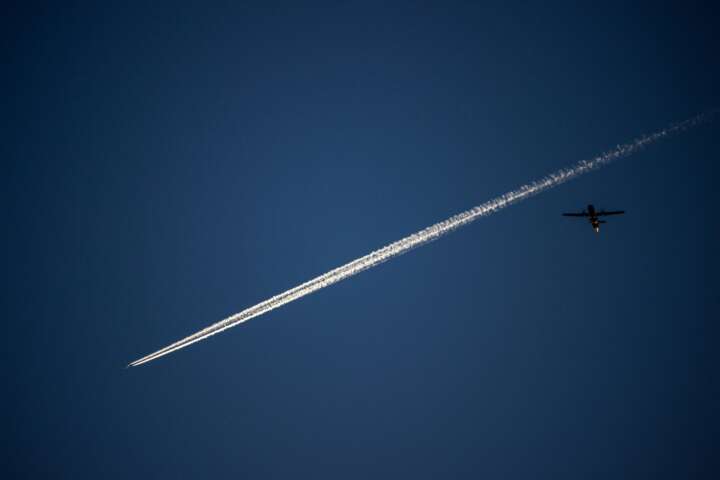
The good news is that contrails should be fairly easy to eliminate. Studies have shown that they are formed on a relatively small proportion of flights – mostly at night in winter over the North Atlantic, and continental Europe. Re-routing aircraft to fly around the extra cold areas where contrails are likely to form (contrail avoidance) is a relatively straightforward solution, which could be introduced by national air traffic control centres.
Explore more research on contrails from www.contrails.org